INTRODUCTION TO THE DECISION-MAKING FRAMEWORK, Book, Forthcoming 2nd Edition, Decision-Making Throughout the Life Cycle
Physical asset lifecycle management is the strategic process that guides all decision-making aimed at realizing the asset’s full potential value, taking into account costs, risks, efficiency, and benefits over its lifespan.
Based on the ISO 55000 : 2024 definition of Asset Management “coordinated activities of an organization to realize value from its assets ” the process begins with a Purpose within a specific Context. Driven by leadership and organizational culture, and guided by governance regarding the “why” of planning and anticipating supported by informed decision-making the organization executes the “how” (identifying needs, exploring, visualizing, designing, creating, acquiring, building, operating, using, maintaining, caring for, sustaining, modifying, improving, renovating, adapting, replacing, decommissioning, disposing of, or abandoning) throughout the asset’s lifecycle. This process involves monitoring and tracking for continuous improvement to deliver product results that yield measurable value, monetized through returns and prosperity.
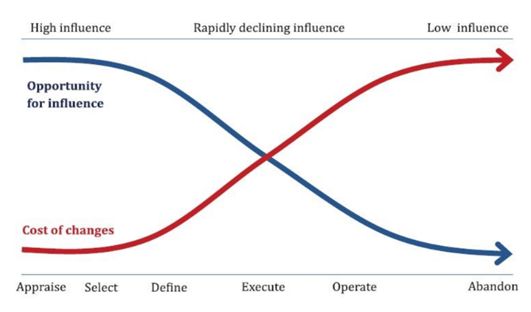
Each decision making phase throughout the asset’s lifecycle influences the realization of potential value or the benefits it delivers to shareholders, customers, or society. The greatest influence on maximizing this value lies in Phase 1 which encompasses identifying needs, exploring, evaluating, visualizing, designing, creating, acquiring, and constructing as part of the Capital Investment Projects process defined in the UNE EN ISO 15663:2021 standard (shown in the image below).:
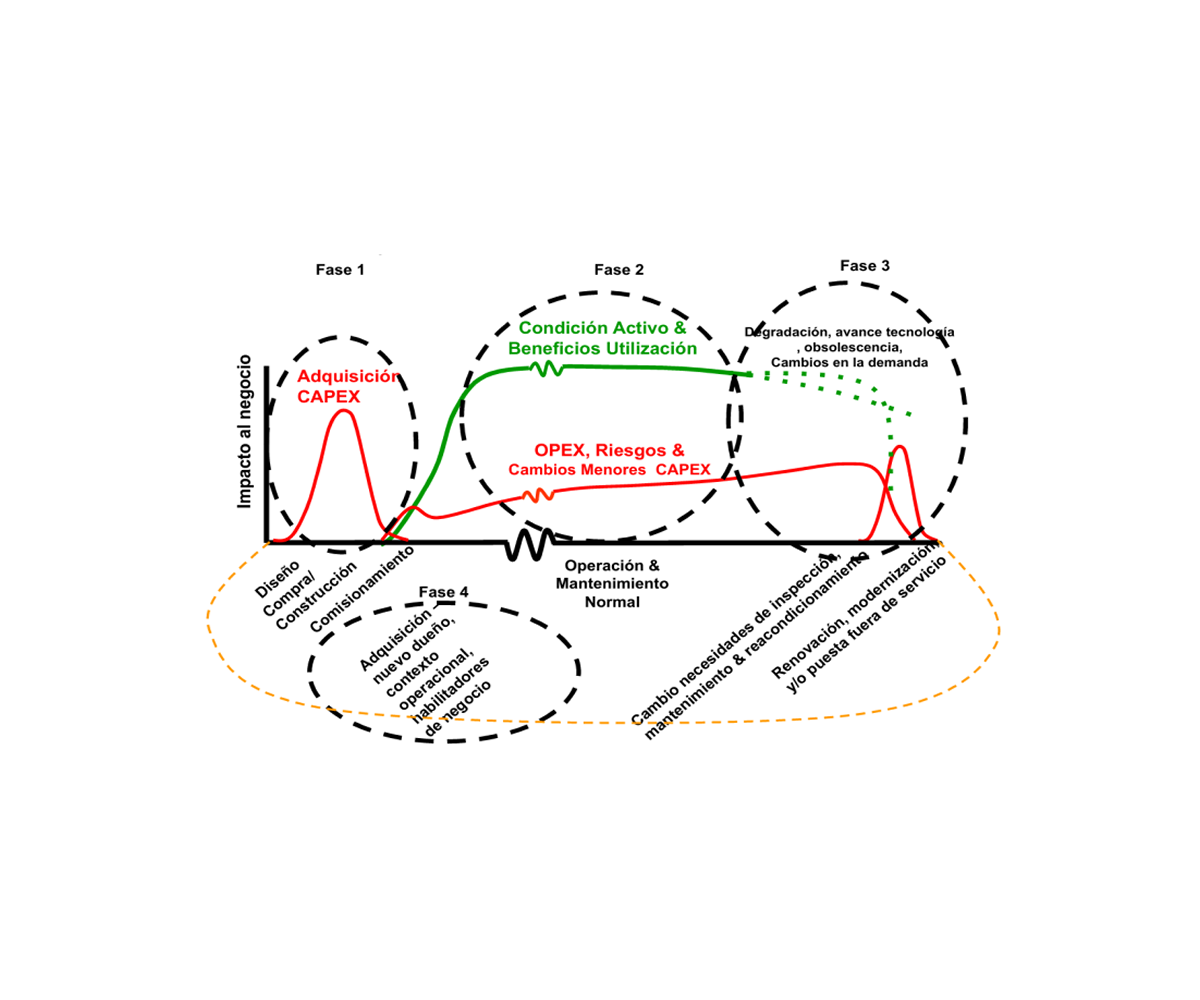
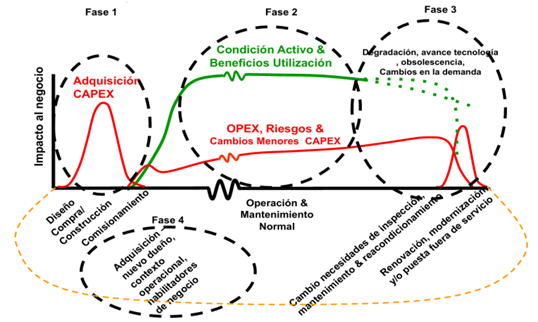
There is a vast array of physical assets, infrastructure, and facilities characterized by aging, low efficiency, technological gaps, and deferred maintenance or upgrades yet they still possess remaining economic life and untapped economic potential. The opportunities to influence their management lie between the operational and abandonment stages, or specifically within phases 2, 3, and 4. Many of these assets are managed based on a certain level of organizational reliability maturity, guiding decisions and actions according to agreed upon criteria some of which are widely used, such as:
- Strategic Planning Processes and Capital Investment Projects:
- Key decision: Evaluate the actual need, technical feasibility, and financial analysis (CapEx vs. OpEx).
- Criteria: Determine whether it is better to buy, lease, or build; define the capital investment project, taking into account projected technical and economic useful life.
- Procurement Processes for Project Acquisition and Construction.de Procura para la Adquisición y la Construcción del Proyecto.
- Key decision: Selecting the right supplier and evaluating purchase costs against long-term operating costs.
- Criteria: Do not base the choice solely on the purchase price; factors such as quality, reliability, safety, warranties, technical support, installation costs, and after-sales service and support must be analyzed.
- Operation and Maintenance Processes:
- Key decision: Maximize asset availability at the lowest possible cost.
- Criteria: Select the appropriate maintenance strategy (preventive, predictive, or corrective) and manage energy consumption, repairs, and staff training. This allows for budget control without compromising safety.
- Decommissioning or Final Disposal Project Processes.
- Key decision: Determining the exact moment to replace, sell, recycle, or decommission the asset.
- Focus: Avoiding excessive costs due to constant failures (obsolescence) and complying with environmental and safety regulations when retiring the equipment.
Many decisions are conditioned by the level of organizational reliability and process maturity within the work system which acts, in a sense, as an entity regulating adherence to criteria agreed upon with stakeholders. Naturally, there remains significant potential within decision making processes to further maximize asset value throughout the asset’s lifecycle; this potential has been linked to two major critical factors: the human element and technology.:
A.- Cultural and organizational:
- Investors, regulators, government officials, and other stakeholders hold a short-sighted or limited view that fails to consider the asset’s entire lifecycle.
- Inadequate communication, competence, leadership, commitment, and collaboration.
- Poor alignment with the strategic plan, siloed agendas, conflicting personal interests, isolated KPIs, partial participation, limited consultation, lack of transparency, and poor traceability.
- Organizational silos and poor coordination across process-based functions and departments (e.g., finance, health and safety, reliability, production, engineering projects, environment, quality, community relations, legal, etc.).
- Analysis paralysis: this occurs when the quest for absolute certainty prevents progress by demanding more reports, simulations, and validations; while the organization appears to be working, it is effectively at a standstill a sophisticated way of delaying decisions, despite the financial cost of inaction.
A well managed company does not need to know everything to move forward; it needs to know enough, accurately assess risks and threats, and make quick corrections if the scenario changes.
B.- Technological factors:
In the new global landscape, security, industry, and innovation are increasingly interconnected within a broad scope: the protection of people and territories goes hand in hand with the protection of critical infrastructure, energy and digital networks, and the communication and essential services upon which the competitiveness and stability of our societies depend.
Artificial intelligence (AI) is a key element of the current technological revolution, holding enormous potential for growth and transformation in both economic relations and social behavioral patterns.
AI systems can operate with a high degree of autonomy and self-learning. Once trained, these systems can independently generate recommendations, decisions, predictions, or content, without the need to know or pre-program the specific data and assessments that gave rise to the results provided by the system.
On the other hand, this autonomy can pose a challenge regarding the transparency and traceability of these systems. The adaptability with which these systems operate after deployment entails risks when their use impacts individuals, society, or the economy.
Therefore, an appropriate regulatory framework for the use of this technology is necessary to promote the adoption of trustworthy, human-centric AI.
Appropriate regulation can foster an approach to AI implementation where complementarity prevails, ensuring that potential productivity gains are compatible with employment growth.
The capacity and reach of this AI technology make it a cross-cutting tool, impacting a wide spectrum of sectors and possessing the potential to generate a positive impact on global economic productivity.
Innovating is vital for competing, transforming, and ensuring long-term sustainability. This requires charting a clear path that aligns technology with business objectives, identifying and prioritizing opportunities for improvement while leveraging the expertise of skilled professionals to make optimal decisions. The goal is to advance through maturity levels toward the adoption of generative AI. All of this relies on systematic processes, skills, and tools that optimize decision making across every phase of the physical asset lifecycle including projects, operations, maintenance, improvements, and decommissioning ultimately delivering strong financial results, risk reduction, clear priorities, investment opportunities, benefits, economic returns, and sustained prosperity.
Sharing data is easy; building ecosystems with value-generating digital assets is the challenge. The challenge lies in structuring data to derive manageable value for optimal decision-making throughout the lifecycle:
- Establish the objectives and processes necessary to achieve results.
- Implement the planned processes for data collection, storage, and processing for advanced analytics and decision-making.
- Monitor and measure processes and products.
- Take actions for the continuous improvement of data performance.
Regulations are moving toward strengthening the governance of the decision-making framework by considering robust, validated lifecycle models that balance costs, risks, efficiency, and benefits; evaluating available options; and deepening the understanding of the accuracy and completeness of the data and information used including uncertainty. Furthermore, these regulations ensure that decision making methods are applied consistently across all asset types and asset systems, serving as a benchmark for similar organizations.
The aim is to apply documented methods aligned with policy, the plan, and management objectives, in accordance with the strategy. Furthermore, decisions take credible alternatives into account; options are evaluated considering constraints, mandatory compliance requirements, and impacts across all lifecycle stages; and records of each decision are maintained. Risks and threats are included in the assessment, with consideration given to how they change over time. Processes and methods are applied consistently across all investments, including new designs, new construction, replacements, and renewals.
The following diagram is a reference example developed during the SALVO (Strategic Asset Life Cycle Value Optimization) project—a four-year research and development initiative that established how to determine and empirically verify the value and timing of capital investment projects, maintenance activities, and asset replacements.
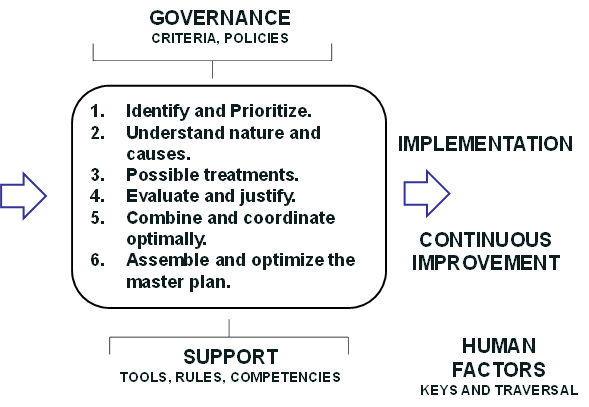
The next step is clear: moving from isolated capabilities to continuous systems and integrating the intelligence of prevention or anticipation and action into a single loop with agents that not only assist but also operate and make decisions; this model will only be viable under human supervision, with continuous governance and technological sovereignty.